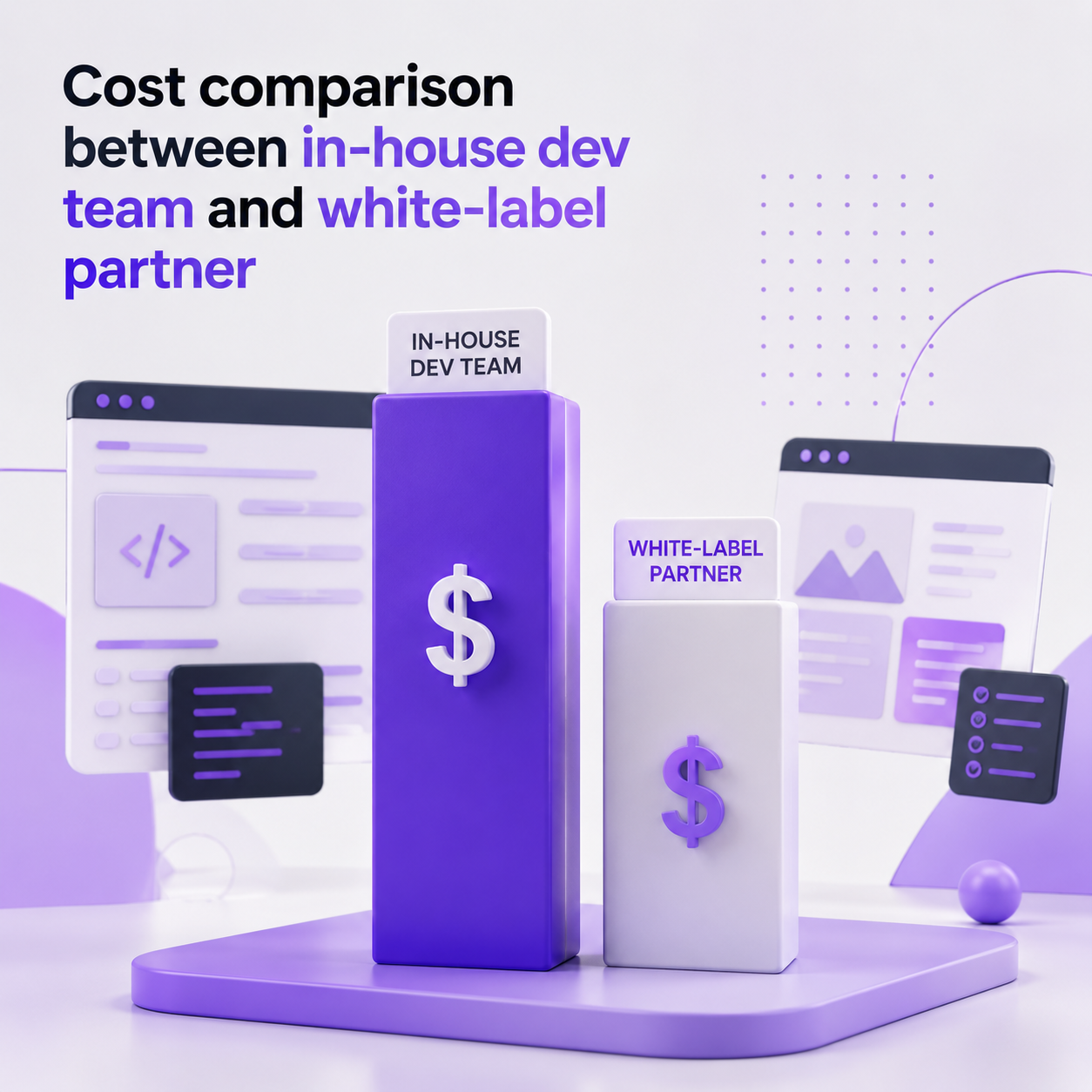
"We'll just hire our own dev team" sounds like the cheaper long-term option. The actual math often says otherwise. Here's a full breakdown of both sides.
A salary line item looks simple next to a monthly retainer invoice. But a salary is a fixed cost regardless of project volume, and most agencies don't have consistently full development pipelines.
It can take 2 to 4 months on average to hire a solid mid-level developer, during which your capacity gap doesn't close.
You carry the full-time cost whether or not there's matching project volume that month.
Someone now has to lead, review, and retain that person. That time is usually pulled from elsewhere in the business.
Payroll doesn't pause when client work slows down. A white-label partner's cost scales with what you actually send them.
Either model scales more directly with actual workload than a fixed salary does.
QA processes, backup capacity if someone's out, and platform expertise across both WordPress and Shopify can all be included without needing to hire two separate specialists.
Take your realistic monthly project volume, not your best-case scenario, and compare it against a full-time salary plus benefits plus management time.
For agencies without consistently high, steady development volume, white-label usually comes out ahead.
Agencies with large, steady development workloads and the management bandwidth to run a team well often do better building in-house long-term.
This isn't a universal argument against hiring. For the right agency, an internal team can absolutely make sense.
For a lot of agencies, the honest answer is that white-label costs less than they assumed and in-house costs more.
It's worth running the real numbers before assuming either way. (For a broader look at how the white-label model works, see our white-label web development guide.)